Criminals aren't inventing new crimes. They're running the old playbook faster, on an industrial scale, with tools that make forged documents and fake identities harder to spot than ever.
That was the starting point for a panel of senior financial crime leaders from major banks on where the function is heading over the next five to 10 years. The room was hooked until the very end, and it was great to see such a mixed audience at a Women in Financial Crime session. The session ran under the Chatham House Rule, so nothing below is attributed to individual speakers.
Old crimes, new speed
The risks are the ones the industry has always faced, "just on steroids now," as the panel put it. One example: an AI-generated passport good enough to get through KYC and screening. Firms will have to use AI against AI to catch it.
The panel also flagged fraud and AML converging. Fraud used to sit apart. Now it is increasingly what generates the illicit funds in the first place.
From compliance-led to intelligence-led
Instead of waiting two years to implement each new regulation, the future function has to act on regulatory signals and turn them into controls much faster. That means responding to public consultations, becoming technology-literate and accepting an 80-20 mindset: you'll get about 80% right, and the rest won't be.
Let the problem pick the technology
"The problem determines the technology," as the panel agreed. Start with how good your data is, how complex the task is and whether you really need generative AI or a simpler model would do. Many wins still come from plain automation.
Then came something I didn't expect to hear from a panel: one speaker has yet to see a firm deploy meaningful AI that meaningfully solves a problem. The reason everyone in the room knew: data lineage, quality and integrity.
Binary tasks suit AI today. Judgment calls don't. "Should we exit this client? I'm not going to ask AI that question," the discussion agreed.
On agentic AI, the panel described three roles: decision-making agents that learn, digital workers that follow procedures, and orchestrators that coordinate them. The open question is where humans sit in that loop.
Is the three lines of defense model dead?
The question many in the room had been wondering about: does the three lines of defense model still work, given how siloed it has become? Discussions are already under way in the UK, including with the FCA, on how first and second line work together.
Inside firms, the divides run not only between lines but between fraud, AML and cyber. Connecting that "trifecta" would mean working "quite a lot differently," with regulators on board. Risk has to be treated as one programme, with roles rethought across functions and across the lines of defense.
Governance at a faster cadence
Existing risk frameworks still apply, but AI amplifies risk in many places at once. Assurance can't run on an annual cycle anymore, and reviews have to keep pace with each model update. "The meaningful human in the loop can't be a rubber stamp."
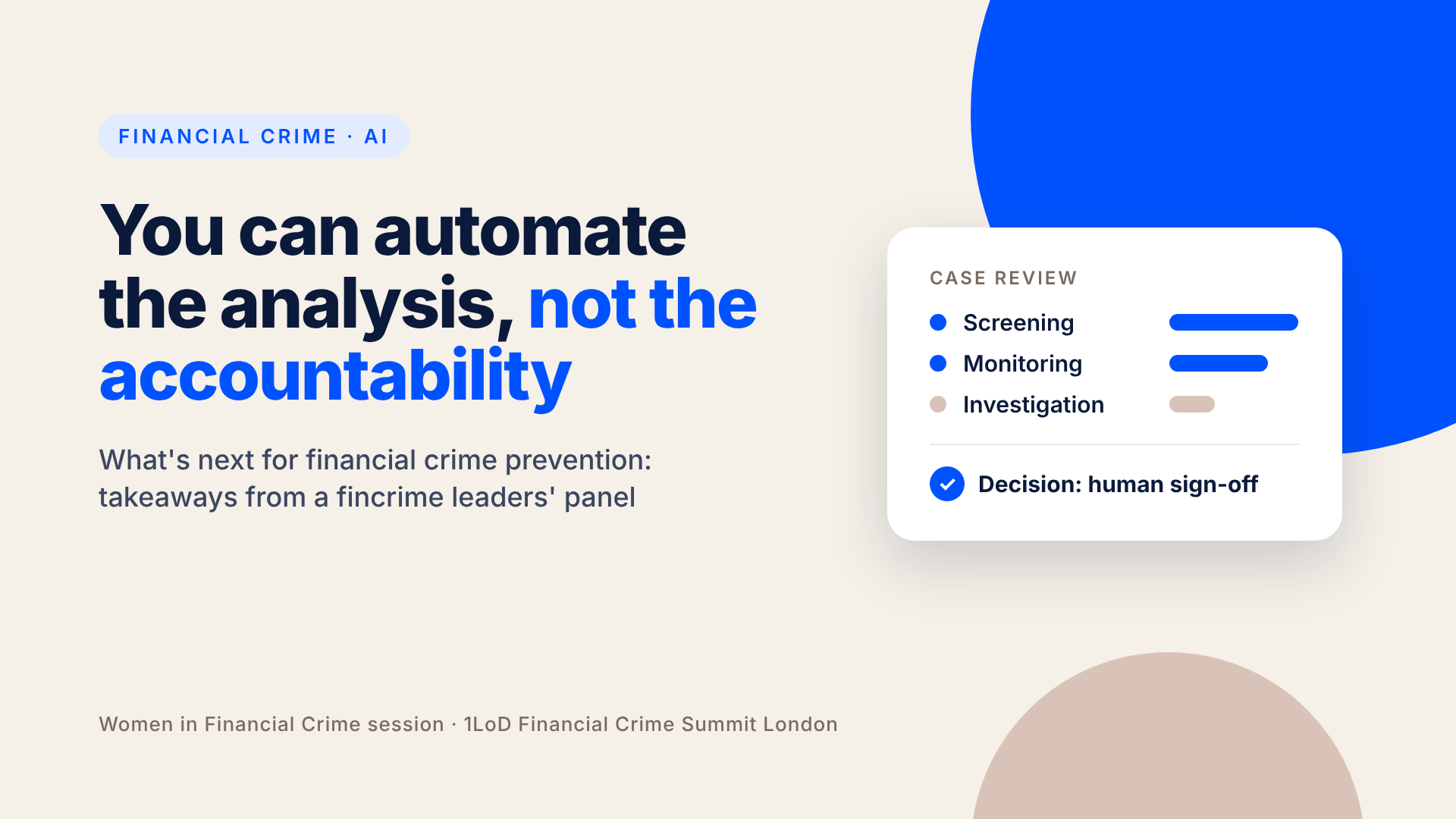
The real change, one speaker argued, is accountability. Analysis can be automated; accountability can't. People at every level will answer for decisions made with technology, and they need the training to sign off with confidence.
What the room said
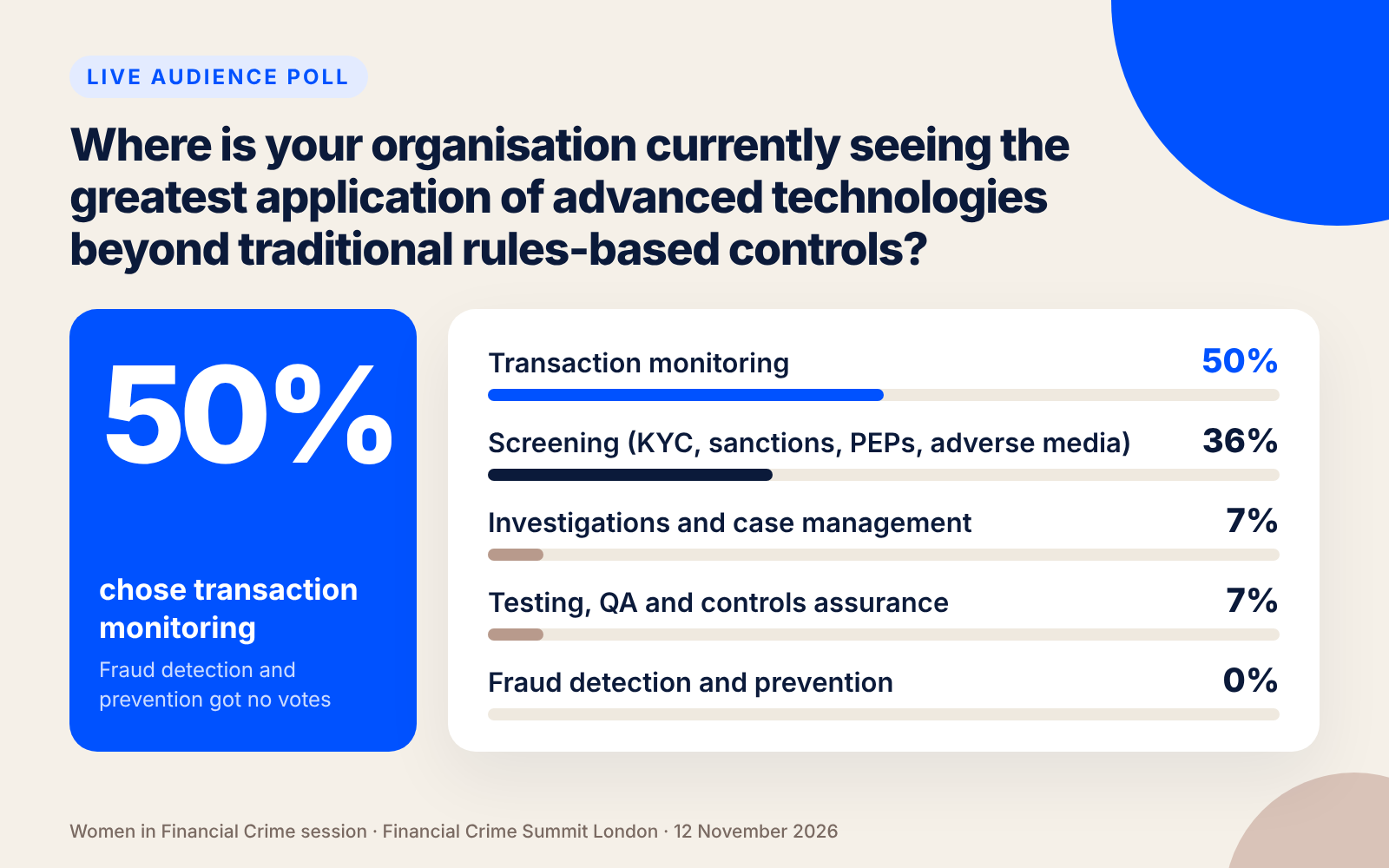
A live poll asked where attendees' firms use advanced technology most beyond rules-based controls. Transaction monitoring led at 50%, followed by screening at 36%. Investigations and testing got 7% each. Fraud detection got no votes at all, which stood out given how much of the discussion was about fraud and AML converging.
The last word: beware automation bias
The warning that stuck with me most: the risk that people stop really looking. Think of an airport security officer scanning X-rays all day. They don't really expect to see a bomb. The more often AI is right, the more people simply accept its output.
The skills that will matter most: curiosity, critical thinking, deep fincrime expertise, knowing where AI fails, and a simple human test: does this actually look right?
What it means for your fincrime team
- Expect old crimes at new speed. Fight AI-enabled typologies with AI.
- Watch fraud and AML converge. Siloed teams will miss it.
- Start with the problem. Data quality is the real bottleneck.
- Govern continuously. Assurance has to keep pace with model updates.
- Keep accountability human. Upskill the people who sign off.
- Watch for automation bias. Curiosity and critical thinking are the skills that will last.
Why this matters to us
At Vivox AI, we build AI agents for KYB, KYC and AML operations with a clear evidence trail behind every decision, so the analyst who signs off can see exactly why, and challenge it. Automation should give experienced people more time for judgment, not less reason to use it.
Held under the Chatham House Rule. Views are not attributed to individual speakers or their organisations.